
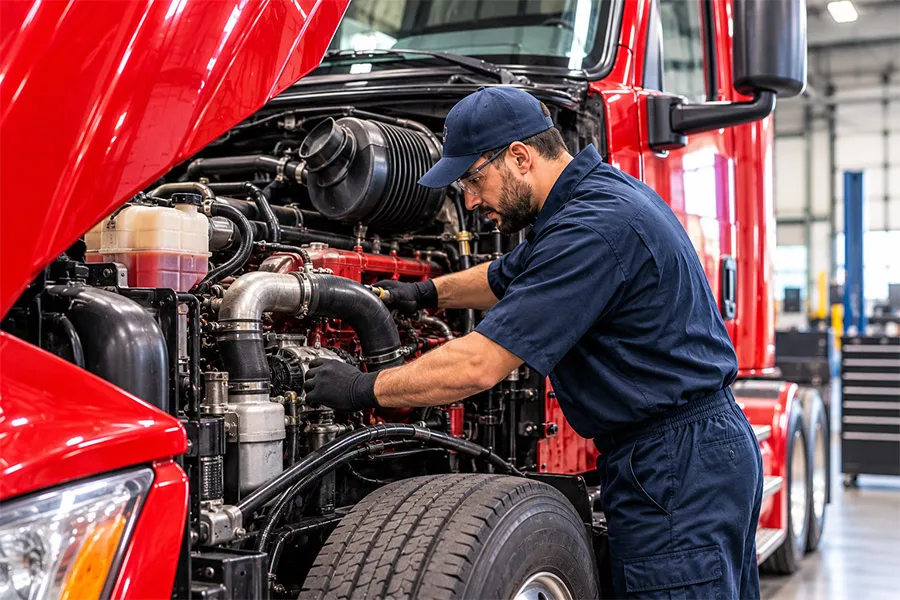
Every fleet manager hits this question eventually: should we build our own maintenance shop, or hand the wrenches to a trusted partner? On paper, in-house maintenance looks cheaper. You pay your own technicians, buy your own parts, and skip the shop's markup. In practice, the real numbers often tell a different story.
Overhead, downtime, tool costs, and technician turnover add up fast. So do the hidden costs of outsourcing when you pick the wrong partner. This guide breaks down the true cost of in-house vs outsourced fleet maintenance in Columbus, Ohio so you can make a decision based on data instead of gut feeling. Whether you run five trucks or fifty, you'll leave with a clear framework for choosing the option that saves your fleet the most money.
Maintenance is one of the largest controllable expenses in any trucking operation. It also affects revenue directly. A truck in the shop isn't hauling freight, and every unplanned day out of service costs you the repair bill plus the lost load, the late delivery, and the frustrated customer.
That's why the in-house versus outsourced debate isn't just about hourly labor rates. The real question is which model gives you the lowest total cost per mile while keeping your trucks reliable and your drivers safe. For fleets running through Columbus and across Ohio, where road salt, heavy summer heat, and busy interstate corridors all take a toll, that answer matters even more.
Running your own shop gives you control. But control comes with a long list of expenses that many operators underestimate when they build their budget. A realistic look at in-house fleet maintenance cost has to include both the obvious and the hidden line items.
An in-house operation can absolutely make financial sense. It works best when you have enough trucks to keep technicians busy every day, the capital to build the shop properly, and the management bandwidth to run it well.
With outsourced fleet maintenance in Columbus, Ohio, you pay a service provider to inspect, repair, and maintain your trucks. The most obvious cost is the shop's labor rate and parts markup. But that's only part of the picture.
Outsourcing isn't automatically cheaper. Poor communication, slow turnaround, inconsistent repair quality, and vague invoices can all erase the savings. The key is choosing a partner who treats your uptime as seriously as you do. A shop that doesn't understand fleet operations will cost you more in the long run, no matter how low the hourly rate looks.
Here's how the two models compare across the factors that matter most to your budget. Use this as a quick fleet maintenance cost comparison for your own operation.
Numbers vary by fleet, but a simple illustration shows how the math can shift. Take a 10-truck fleet running regional routes. An in-house shop would need at least two experienced technicians, a facility, tooling, diagnostic software, insurance, and a working parts inventory. Even before the first repair, the fixed overhead can run into six figures every year.
Now divide that overhead across your trucks. If your annual maintenance workload could be covered by a shop at a fraction of that fixed cost, the outsourced model wins, even with the shop's markup included. If your fleet is large enough to keep a full team busy every hour of every day, the in-house model starts to close the gap.
These figures are illustrative. Run your own numbers using your real labor costs, parts spending, and downtime to find the best way to reduce fleet maintenance costs.
Most cost comparisons stop at labor and parts, but downtime is often the biggest line item. Think about what a single day out of service costs your operation in lost revenue, late fees, and customer goodwill.
A strong preventive maintenance program is the best way to cut downtime, and it's where outsourcing often shines. A partner who tracks service intervals, flags upcoming work, and schedules repairs around your routes helps you catch small problems before they become roadside breakdowns. A well-run fleet preventive maintenance program in Ohio keeps your trucks moving and your costs predictable, because scheduled service always costs less than an emergency repair.
If outsourcing looks like the right move, pick your partner carefully. The right fleet maintenance partner in Columbus should check these boxes:
At Fleetbarn, we built our Columbus operation around one idea: your trucks make money when they're moving, so our job is to keep them moving. Here's what sets Fleetbarn apart.
When you partner with Fleetbarn, you get the benefits of a fully equipped shop without the capital, payroll, or management burden of building your own.
Not always. In-house maintenance can lower your per-job cost at very high volumes, but fixed overhead, including technician payroll, facility costs, tools, software, and parts inventory, often outweighs the savings for small and mid-size fleets. Compare your full annual in-house costs against what you'd spend with a shop to see which wins for your operation.
The biggest benefits are lower upfront investment, predictable cost-per-job pricing, access to a team of experienced technicians and specialized equipment, and the flexibility to scale as your fleet changes. A good partner also helps reduce unplanned downtime through scheduled preventive maintenance.
Look beyond hourly labor rates. For in-house shops, include facility costs, diagnostic software licenses, tool replacement, parts inventory carrying costs, technician turnover, and management time. For outsourced service, factor in turnaround time, communication quality, and warranty terms. Downtime is the cost most fleets forget, and it is often the largest one.
Focus on preventive maintenance. Regular inspections, on-time service intervals, and good record keeping catch small issues early and prevent expensive breakdowns. Track your cost per mile, review repair trends by truck, and work with a partner who gives you clear data on what's driving your costs.
The right choice between in-house and outsourced maintenance depends on your fleet size, budget, and goals. But whichever way you lean, one thing is certain: guessing is expensive.
Talk to the team at Fleetbarn. We'll look at your fleet, walk through your maintenance needs, and show you how outsourced service could lower your costs and cut your downtime. Call us, book online, or stop by our Columbus location today, and let's build a maintenance plan that keeps your trucks earning.
3781 Sullivant Ave,
Columbus, OH 43228
614.812.BARN (2276)
Email Inquiries
General: info@fleetbarn.com
Service: service@fleetbarn.com
Accounting: acct@fleetbarn.com
We accept Cash, EFS Checks, Comcheks, and all major Credit Cards

© 2025 Copyrights. All Rights Reserved.